|

Site Updated: 11 June 2025
Contact Axman at..........
joe.axman.mac@gmail.com






|

Thanks for visiting my web site.
I am updating the web site. Please clear your browing data and cookies and the "revised" site should pop up. If
you don't you may order something I discontinued.
THANKS FOR VISITING MY WEBSITE. JESUS CHRIST HAS BEEN SO GOOD TO ME. I THANK HIM FOR CUSTOMERS LIKE YOU. A PORTION OF ALL SALES
GOES TO SUPPORT SPREADING THE GOSPEL. THANKS AGAIN!
CHECK OUT THE NEW BARBLESS SASSY HEADS. NEVER RIP YOUR PLASTICS AGAIN!!
I retired eight years ago (former engunear). I tried to retire from the lure business last year but so many
folks wanted me to keep going, I did. Thanks to all you folks, the lure business has been very successful!!
So order away. Food prices, gas prices, etc. are up!
I ve been doing it for over 60 years. Why
stop now?
Why do I do it?
I modified my first lure when I was about 10 years old. My Dad took time
to take me fishing. By the time I was 12 years old, I had mastered the fly
rod and my Dad and I dragged more bream and bass from Mississippi farm
ponds than I can remember. It was a wonderful time in my life. I miss him
dearly.
One day, we were not catching much. We could hear the sucking sounds of
bream but they would not hit. I was using a small yellow fly. My Dad was
using the same fly but in an orange color. I had just popped a piece of
Juicy Fruit gum in my mouth and the thought occurred to me to wrap a
piece of the foil around the fly. I took a tiny piece, wrapped it around
the fly, and cast it out there. It was an ugly cast. The modified lure hit
the water, I twitched it a couple of times, and a few minutes later, had a
2 pound bass in the boat.
I ve been dinking with lures for 60 years. Lots of failures. Lots of
successes. Lots of fish caught. Lots of fish lost. The one thing I ve
learned over the years: fish like contrast .just like structure, they like
contrast in the appearance of their food. When the lure is some distance
from the fish, contrast makes the difference between a strike and just
another cast.
What have I learned about a fish looking for something to attack?
(1)
Fish don t see very well at a distance (you have to get their attention)
and
(2) they see in color and they like green chartruese, yellow chartreuse, white, orange, and pink.
If you want to check out what colors are best just look at a skin diving magazines and see what colors the wet suits are.
Fish
do not have binocular vision like we do. Their eyes are on the side of
their head. Therefore, they have a semi-blind spot between their eyes.
They don t really see their prey well at a distance. They can see well up
close but at a distance, the lure has to get their attention and to get
their attention there has to be some bright green, white, bright yellow, orange, pink, or flash. Ever see
any lures painted in flat or matte paint? My point exactly.
Fish have an additional ability: (3) they can see in the ultraviolet
range. While humans see seven colors; fish see these plus some. That is why
on a given day, take two lures that are identical in every detail but color
and the fish will hit one color but not the other. Most of us have
experienced this.
In summary, fish do not see well at a distance so
contrast in your lures, different colors in the lures, and different sizes
of your lures increases your chances of catching those rascals.
Fluorescent colors (glow) are popular because they retain light and glow
underwater. What they really do is become visible in the ultraviolent
spectrum making it easier for the fish to see them..you have to get their
attention.
Last but not least (4) The fact that fish see in color is important. With the exception
of those species that live in water sufficiently deep to filter out all
color, fish see in color and the color most fish prefer is red. Not
necessarily an all red bait, but they prefer a food that has a bit of red
in it (or orange or pink). Why? Because most fish have red on them! When
looking at the physics of the color spectrum, e.g. wavelengths, red is the
first color in the color spectrum to disappear. This makes red a great camo
color for a fish. Red will show up sorta like the color of a crayfish.
What a conundrum if you re a fish! You are red in color
and that s good because you tend to disappear if you head to deep water
to avoid being a meal but at the same time, you look for other fish to eat
and you look for red. Hmmmm .
These facts guide me in practically every lure I make. Contrast in color by
adding black, red, orange, or pink color in them to some degree. Science
has proven this to be the most common colors in fish. So, why would you
choose a lure that did not have some degree of "nature" in it?
BUT ONE IMPORTANT THING, I MAKE 100's OF LURES FOR PROFESSIONAL GUIDES. WHAT I HAVE LEARNED FROM THEM
IS REFLECTED IN MY COLOR SCHEMES.
I was asked why your lures are more expensive than some lure guys. (1) I don't buy from China (2) My lures
are coated with a high tech clear hard coat...the same as sprayed onto exotic cars (3) You'll like 'em.
God has certainly
blessed us with this lake we call Texoma!!
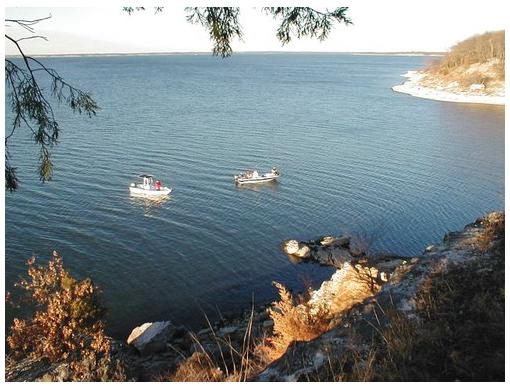
Axman and Fuzzy fish along the shore of
beautiful Lake Texoma!!
Easiest to catch me by email or
ordering off the web site.
If you want to call, please do however I ain't hooked to my telephone so it
might take a while for me to call ya back. I'm not anti-social but I find
it much faster and more efficient to send a text or email.
I don't sell lures out of my home. I tried that one time and had people
knocking on my door at 10 p.m. so I don't do that anymore. I go to bed
early. :)
I respond to emails pretty quickly. It's the way I prefer to do biz and
with the low, low, low profits margins in the lure industry, it behooves me
to do things the easy way. I do provide the best customer service possible
but I protect my personal hours 'cause if I don't, some folks believe it's
a 365/24/7 thing. And it ain't. :)
FIVE YEAR GUARANTEE
ON ALL LURES....IF YOU USE THE SAME LURE FOR 5 YEARS AND DON'T CATCH A FISH
WITH IT, SEND IT BACK AND I'LL REFUND YOUR PURCHASE PRICE....LESS SHIPPING
AND HANDLING!! :)
|